![]() | Bolivia | ![]() |
| Republic of Bolivia | ||
| March 5-6 |
| Americas |
| |||||||||||||||||||||||||||||||||||||||||||||||||||||||||||||||||||||
| Population | Ann.Gr. | Density | |
| 2000 | 8,328,665 | +2.35% | 8 per sq. km. |
| 2010 | 10,229,354 | +1.98% | 9 per sq. km. |
| 2025 | 13,131,183 | +1.49% | 12 per sq. km. |
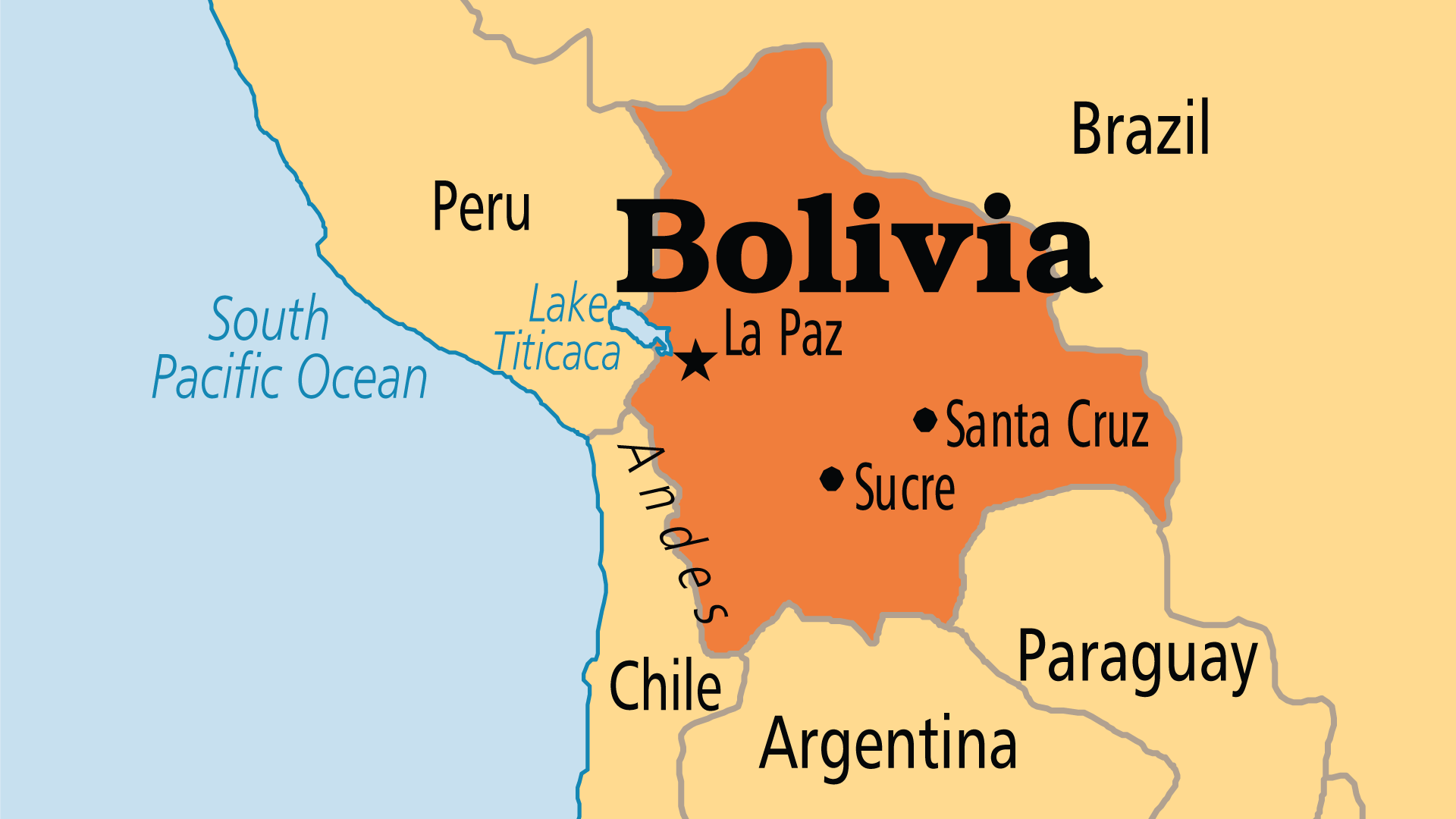
Capital La Paz (administrative) 1,458,000; Sucre (legal) 200,000. Other major city: Santa Cruz 1,110,000. Urbanites 61%.
Mestizo 30.5%. Mixed race, Spanish-speaking, predominantly urban.
Amerindian 63.9%.
Highland peoples 62%. Quechua (5 groups) 4.27m; Aymara (4 groups) 2.62m.
Lowland peoples 1.9%. About 35 groups. A further seven have recently become extinct. Major groups: Chiquitano 34,000; Guarani(2) 36,000; Guarayu 8,000; Tsimane 9,200; Ignaciano 7,700; Trinitario 7,700; Tacana 6,200; Yuracare 3,700; Mataco 2,600; Ayoreo 2,000.
European 5.1%. Mainly of Spanish descent; they dominate the political and economic life of the country. Also Low German (Mennonites) 27,000; Greek 3,000.
Other 0.5%. Japanese 19,000; Chinese 6,000; Jews 3,300.
Literacy 77%; functional literacy less than 50%. Official languages Spanish, Aymara, Quechua. All languages 39. Languages with Scriptures 4Bi 16NT 9por 7w.i.p.
Once South America's richest area, but corrupt, unstable governments, the fall in silver, tin and cotton prices on the international markets, and lack of adequate roads and railways led to decline and economic disaster in the 1980s. Reforms since 1984 have reversed the decline. Shared responsibility for ending illegal cocaine exports between the consumers and producers is bringing in foreign aid to build a more healthy agricultural industry. HDI 0.652; 112th/174. Public debt 55% of GNP. Income/person $830 (3% of USA).
Independence from Spain in 1825 after a long war for freedom. Over 200 successful coups or revolutions have held back meaningful progress. Between 1985 and 1994 successive democratic governments have stabilized the country and given cautious hope for improvement. Since 1994 there has been increasing recognition of the rights of the underprivileged indigenous peoples. The vigorous efforts to suppress coca growing is causing stress and controversy in the country.
The Catholic Church retains State Church status, but rapid growth of non-Catholic religious bodies has threatened this. Religious freedom and separation of Church and State is not yet fully resolved. About 60% of the population has been baptized Catholic, but are practicing animists or Christo-pagan, so statistics here must be interpreted in this light. Most of the Quechua and Aymara are in this category.
| Religions | Population % | Adherents | Ann.Gr. |
| Christian | 93.91 | 7,821,449 | +2.3% |
| Baha'i | 3.23 | 269,016 | +2.8% |
| non-Religious/atheist | 1.72 | 143,253 | +3.1% |
| Traditional Ethnic | 0.82 | 68,295 | +1.4% |
| Chinese | 0.20 | 16,657 | +2.4% |
| Buddhist | 0.06 | 4,997 | -0.5% |
| Jewish | 0.04 | 3,331 | +2.4% |
| Muslim | 0.02 | 1,666 | +9.7% |
| Trans-bloc Groupings | pop.% | ,000 | Ann.Gr. |
| Evangelical | 11.8 | 981 | +5.6% |
| Charismatic | 9.8 | 817 | +4.7% |
| Pentecostal | 4.5 | 372 | +7.8% |
Missionaries from Bolivia
P,I,A
95 in 16 agencies to 9 countries: Bolivia 79.
Missionaries
to Bolivia
P,I,A 1,790 in 100 agencies from 28 countries: USA 495,
UK 110, Brazil 94, Korea 50, Sweden 35, Switzerland 33.

1 The 40 year responsiveness of many sections of the population has continued through the 1990s, with Evangelicals increasing from 600,000 to nearly 1 million.
2 The Aymara, descendents of a great pre-Inca civilization, continue to turn to Christ with over 20% now evangelical believers.
3 The long-indifferent Quechua have begun to respond to the gospel in large numbers in the 1990s.
4 A significant spiritual hunger and turning to God in the Bolivian army.
1 Democracy and freedom are new realities for Bolivia. The benefits are only now beginning to reach the Amerindian majority that has long been mired in poverty, exploited and politically marginalized. Pray for courage and moral integrity for the national leaders as they grapple with the economic inequalities and social ills of society, not least of the latter being the cocaine "industry". About 50% of the world's cocaine is grown in Bolivia. Pray that Bolivian Evangelicals may live holy, exemplary lives as they seek to bring change for the good of their land.
2 The growing of coca and manufacture of cocaine have become the major economic activity of many Bolivians. Poor roads and distance from markets make alternative crops far less viable. Government and international efforts to suppress the illegal industry have had limited success. Pray for believers that have compromised, and also for those who stood against the pressure and are impoverished as a result.
3 The Catholic Church is confronted by multiple crises. Its long-held political supremacy is threatened; annual losses to other churches and religions have provoked local discrimination and pressures against non-Catholics. It has failed to develop an indigenous clergy or challenge the rampant paganism within the majority it claims to shepherd. Pray that millions of nominal and Christo-pagan “Catholics” might come to a living faith in Christ.
4 Evangelical Christians are a growing influence in society. The Association of Evangelicals (ANDEB) is a major fellowship link for them. Pray for unity and continued commitment to prayer and outreach with a vision to see their nation transformed.
5 The spiritual darkness of centuries is beginning to be broken, but Christians need to grapple in prayer with the entrenched idolatry and pagan superstitions of society, the injustices, corruption and vested interests of those with power and, above all, to strip the 'strong man' of his long-held possessions.
6 Growing churches are numerous, but so also are the needs and challenges. These include illiteracy, lack of understanding of the basics of true Christianity, apathy and widespread compromise with the social evils of fornication, family breakdown, violence and alcohol abuse. Pray for revival.
7 Leadership training at various levels is vital for the many growing churches from jungle village tribal churches to sophisticated elite city congregations.There are over 30 Protestant seminaries and Bible schools as well as a variety of TEE institutes and BCCs. These cannot provide maturity and spiritual authority without the deep working of the Spirit of God. Men and women who know their God are needed!
a) The upper classes have long held exclusive control of the reins of power, but were shocked by the national disasters of the '80s. Few were evangelicals before 1985, but all is changing and many are seeking the Lord. The Ekklesia Church came out of the 1986 revival; many of its members are from this class.
b) The rural villages a high proportion of the Quechua, Aymara and lowland peoples live in hard-to-access mountain or forest regions. Well over half of these villages are beyond the reach of present efforts.
c) The 100,000 tertiary students in the nine universities are disillusioned with traditional Catholicism, often secular, promiscuous, consumed with feelings of guilt and inadequacy and discouraged by interrupted courses and bleak future prospects. About 500 students in eight universities are linked with the CCU(IFES); others are linked with the ministry of CCCI in several universities.
d) The youth are largely neglected, yet over 53% of the population is under 19. Few churches know how to meet their spiritual needs. Unemployment, urban violence and increasing drug abuse intensify the growing generation gap. Pray for the work of SU and others seeking to reach and disciple the youth.
e)Children. Over 80% live in extreme poverty, and 100,000 under 14 in urban areas have to work. Over 80,000 are known to be addicted to drugs. Pray for the development of childrens' ministries and for churches to see the importance of these.
9 The lowland tribes have been largely evangelized through great sacrifice and with considerable success. Praise the Lord for the work of NTM, SIM, WGM, UWM, South American Mission, SIL and others. Their ministries have been strongly attacked by anti-Christian anthropologists and commercial exploiters of these lands as "genocidal", but in answer to prayer the effects of these attacks have been reduced. Pray for the neutralizing of these assaults, the maturation of indigenous leaders, the integration of these believers into Bolivian life, the sound conversion of the second generation of Christians and the development of a healthy indigenous Christianity as part of their culture.
a) Bolivia to be 30% evangelical by 2010.
b) A strong Church active in outreach and missions. The missions vision is slowly growing, some Bolivians have been sent to other lands.
c) Strong, servant leaders who give a good role model to others.
d) Effective DAWN programme accomplished with a church in every community.
11 Foreign missions. Early missionaries struggled long against hostility, persecution and harsh living conditions before the harvest ripened. The contribution of AEM (now SIM) was unique in pioneering most of the major gospel advances and ministries in the country, but the work of AoG and Ekklesia is also significant in new visions and advance. The missionary body now needs to concentrate more on leadership among the Quechua, Aymara and upper classes and the discipling of the youth. Major missions include NTM (136), SIM (88), LL (84), GMU (70), AoG (53), WGM (40), Christian Brethren (38), Mennonites (38), South American Mission (34), Swedish Free Mission (33), IMB-SBC (27), Swiss Indian Mission (23), Norwegian Lutherans (21), YWAM (21). There are six Korean missions in the country, and Koreans have founded two of the three Christian universities.
12 Bible translation and distribution. The Bible Society has played a major role in every aspect of Bible work and now has its own press. Over one million New Testaments have been distributed in schools. The Aymara and Quechua Bibles are in great demand but effective literacy programmes are a vital need. SIL has almost achieved the objective of completing the Bible translation programme for all the Amerindian languages that warrant it. There are still 7 languages in which translation work continues and 3 more need a translation survey. May God's Word become part of the life of the entire nation!
a) TV and radio have continued to make a big impact. A radio is a vital possession in every family. Local radio stations have an increasing listenership Ekklesia with its commercial Christian radio, Musoj Chaski radio in Quechua launched by NTM, SIM, Pioneers, and others. International stations (HCJB, TWR, FEBC and others) broadcast daily in Spanish and HCJB especially in Quechua and Aymara. Pray for this vital medium in a country where all other media are restricted in impact by illiteracy, poverty and isolation.
b) Christian literature especially tracts, teaching materials and books is in short supply in Aymara and Quechua. SIM have a significant ministry in this area. There are 13 Christian bookstores.
c) The JESUS film, widely used with considerable impact in Spanish, Aymara, Quechua and Chiriguano, has been seen by a high proportion of the country on television, video and in the cinema.
The above information and prayer material is an excerpt from the full text of Operation World for today's date. To view the prayer calendar for the year click here. If you would like the material for other days in the prayer calendar, you can purchase Operation World (click here for more information). Operation World content © 2001 Patrick J. St. G. Johnstone. All Rights Reserved. See Policy for use and reproduction permissions. Published by Paternoster Lifestyle (an imprint of Paternoster Publishing). Web site development by Global Mapping International.