Congo-DRC
Democratic Republic of Congo (Formerly Zaire)
April 14-15
Africa


click to enlarge

GEOGRAPHY

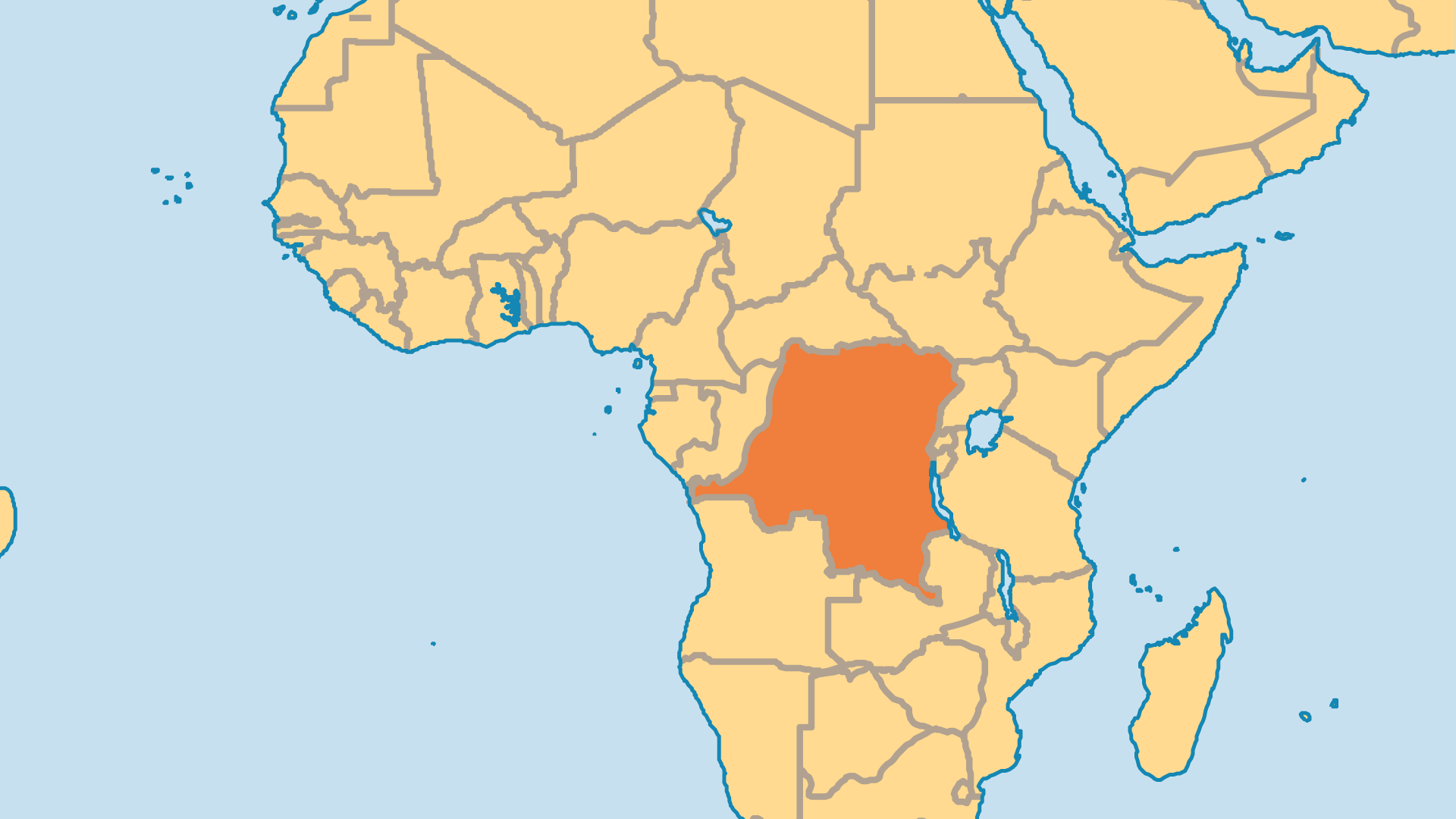
Area 2,344,858 sq.km. Congo contains most of the Congo River system and much of the vast Central African rainforest.

Population Ann.Gr. Density
2000 51,654,496 +2.61% 22 per sq.km
2010 69,389,334 +2.98% 30 per sq.km
2025 104,787,601 +2.58% 45 per sq.km

Large areas are sparsely populated.

Capital Kinshasa 5,950,000. Other major cities: Lubumbashi 1,050,000; Mbuji-Mayi 1,050,000. Urbanites 29%.

PEOPLES

An estimated 450 ethnic and linguistic groups; numerous sub-groups.

Bantu 82.4%. Over 300 ethnic groups speaking over 150 languages in centre and south. Largest: Luba(2) 8mill.; Kongo and Kituba 7.9m; Lingala 1.9m; Tetela 1.1m; Songe 1.0m; Swahili 1.0m; Shi 980,000; Nkundu 910,000; Nandi 900,000; Yombe 780,000; Chokwe 750,000; Ngala 735,000; Lega(2) 700,000; Mongo 675,000; Phende 630,000; Haavu 595,000; Tabwa 590,000; Lala-Bisa 540,000; Banyamulenge (Tutsi living in Congo) 500,000.

Sudanic 13%. Possibly 100 peoples speaking more than 50 languages in north. Largest: Ngbaka 1.27m; Mangbetu 910,000; Lugbara 840,000; Lendu 800,000; Azande 730,000.

Nilotic 1.5%. 4 peoples in north-east. Largest: Alur 750,000.

Pygmy 0.9%. Over 450,000 in 12 peoples scattered through the country's forested regions.

Other 2.2%. Refugees from Rwanda, Burundi and Angola, Westerners, South Asians (140,000).

Literacy officially 77%. Greatly reduced by the collapse of the education system. Official languages French, English. Trade languages Lingala/Bangala in north and northwest, Swahili in east and south, Luba in centre and Kongo/Tuba in west. All languages 221. Languages with Scriptures 27Bi 10NT 40por 27w.i.p.

ECONOMY

Vast mineral resources and agricultural potential. Post-independence chaos, widespread maladministration and corruption enriched the powerful elite but impoverished the nation. The road system hardly functions and continues to deteriorate. Trade has been reduced to a trickle and profitable agricultural estates have reverted to forest. Africa's potentially most wealthy nation can no longer feed its own people, and is dependent on foreign aid. Former President Mobutu's dictatorial misrule was dedicated to plundering the nation's resources for his personal enrichment and that of the sycophants around him. This and the current wars have virtually destroyed the formal economy and the functions of state, with devastating effects on the population. HDI 0.479; 141st/174. Public debt 166% of GNP. Income/person $110 (0.4% of USA).

POLITICS

For centuries, Congo has suffered the depredations of Arab slavers, Western exploitation and, in recent years, exploitation by Africans. For 60 years a Belgian colony. Precipitate granting of independence to an unprepared people led to years of violence, anarchy and secessionist wars, culminating in Mobutu's military coup in 1965. Under his dictatorship, supported and condoned by the West, opposition was suppressed and subverted. Corruption spread through the whole country with Mobutu and his cronies at the apex. The Great Lakes War in Rwanda and Burundi spilled over into eastern Zaire and the area of the Banyamulenge (Tutsi) with their resentment at being denied citizenship rights in Congo. This led to Kabila's coming to power in 1997 with Rwandan and Ugandan support. Kabila's rule was erratic and autocratic, leading to further war, invasions from Uganda and Rwanda and, ultimately, in his own murder. Kabila's regime was shored up by massive military aid from Angola, Zimbabwe, Namibia and others. Kabila was assassinated in 2001 and his son appointed in his place. The country is effectively partitioned between the Kabila faction and its allies in the west, and three or more armies in the east. All international efforts to obtain a cease-fire and eventual peace have foundered on the greed, intransigence and pride of the various nations and factions involved. Prospects for peace, inter-ethnic harmony and progress still looked distant in 2001, but had become more hopeful.

RELIGION

In 1972 the President decreed that only six organized religions were permitted to operate and own property: Catholic; one Protestant Church (ECC), Kimbanguist Church, Orthodox, Muslims and Jews. The authenticity programme of the government between 1971 and 1978 placed controls and limitations on Christian institutions and activities. Economic disasters forced change and from 1980 onwards there has been religious freedom and a return to Christian control of a large proportion of the education and health services.

Religions Population % Adherents Ann.Gr.
Christian 95.29 49,221,569 +2.7%
Traditional ethnic 2.44 1,260,370 +1.3%
Muslim 1.10 568,199 +0.8%
non-Religious/other 0.56 289,265 +1.2%
Baha'i 0.43 222,114 -0.4%
Hindu 0.18 92,978 +5.1%

Christians Denom. Affil.% ,000 Ann.Gr.
Protestant 102 23.77 12,280 +2.7%
Independent 106 22.17 11,450 +2.8%
Anglican 1 0.72 370 +3.6%
Catholic 1 44.53 23,000 +0.0%
Orthodox 1 0.01 5 -3.6%
Marginal 2 0.79 406 +0.7%
Unaffiliated   10.84 5,588 n.a.
Doubly affiliated   -7.55 -3,900 n.a.

Churches MegaBloc Cong. Members Affiliates
Catholic C 14,858 13,372,093 23,000,000
Kimbanguist I 14,000 3,500,000 6,500,000
New Apostolic I 1,800 530,000 1,450,000
ECC-Presbyterian P 525 1,001,000 1,250,000
ECC-United Methodist P 3,750 450,000 900,000
ECC-Disciples of Christ P 1,506 378,947 720,000
Seventh-day Adventist P 1,200 350,000 550,000
ECC-Pentecostal ZEM P 1,667 250,000 500,000
ECC-Baptist-River P 229 216,538 450,000
ECC-Baptist-West P 600 252,000 420,000
Jehovah's Witnesses M 2,618 113,245 400,000
Anglican A 1,000 110,000 370,000
ECC-CECCA (WEC-rel) P 1,800 120,000 330,000
ECC-AoG,USA [2] P 1,603 160,000 290,681
ECC-CECA (AIM-rel) P 1,950 100,000 210,000
ECC-Evang Covenant P 940 120,000 200,000
ECC-CMA P 589 99,557 177,319
ECC-Baptist-Kivu P 280 97,250 160,000
ECC-Evang Free (Ubangi) P 1,226 114,000 160,000
ECC-Mennonite Brethren P 400 90,000 160,000
ECC-Mennonite P 950 100,000 140,000
ECC-Free Methodist P 950 57,000 130,000
ECC-Ev Ch of Lubongo P 1,054 74,850 125,000
Ch of God (Cleveland) P 398 54,369 80,000
Other denoms [190]   21,914 3,192,757 8,860,000
Doubly affiliated     -1,950,500 -3,900,000
Total Christians [215]   77,807 22,953,600 43,633,000

Trans-bloc Groupings pop.% ,000 Ann.Gr.
Evangelical 19.4 10,031 +2.7%
Charismatic 15.8 8,162 +2.1%
  Pentecostal 7.9 4,098 +2.9%

Missionaries from Congo (DRC)
P,I,A estimated 445 in 39 agencies – figures much lower by 2001. About 44 outside Congo.

Missionaries to Congo (DRC)
P,I,A estimated 650 in 76 agencies from 26 countries: USA 400, UK 80, Australia 29, Nigeria 21. C 5,000.


click for legend

Answers to Prayer

1 The Church has gained in stature as the only viable national structure to endure in the general social, political and economic collapse of the country.

2 The turning to Christ in the 20th Century (see graph)! The number of Christians has grown from 1.4% of the population in 1900 to over 90% professing Christianity today. Though much of this would be nominal, there have been revivals in some areas before and after independence.

3 The many prepared to pay the price for this harvest. Thousands of Christians and hundreds of Catholic and Protestant missionaries were martyred in the Simba Rebellion of 1964. Serving the Lord in Congo is still fraught with perils.

4 There has been a large increase in commitment to prayer, stimulated by the nation's calamities , involving millions. The result is full churches and a hunger for God.

5 The long-despised and neglected Pygmy people have turned to Christ in large numbers in some areas and during the 1990s there developed a growing indigenous church movement among them.

Challenges for Prayer

1 Congo's war has embroiled the military forces of seven nations and provoked the rise of local inter-ethnic conflicts and warlords. Rwanda hunts down Hutu genocidists, Uganda exploits the wealth of the north-east, Sudan seeks to harm Uganda, Angola aims to liquidate UNITA rebel bases in Congo and Zimbabwe's army is used to enrich its generals and politicians. Pray earnestly for:

a) Peace. Much of the country has become a war zone. Nearly three million are estimated to have lost their lives through war, violence, starvation and virtual collapse of the health system. A tide of 1 to 3 million Rwandan, Burundian and Congolese refugees and rebels flows across the land and spills over into neighbouring countries. Pray that international efforts to broker a cease-fire and peace agreement may succeed despite the entrenched vested interests that profit from the conflict.

b) The binding of the demonic powers and the human sin that has brought such havoc and suffering through tribalism, extreme cruelty, greed and corruption – yet in a land that has such a large number of professing Christians.

c) The establishment of an effective national government which has the support of the people and which will rule with honesty, justice and respectful concern for the interests of the governed.

d) Economic recovery and wise use of finances to pay government officials, the military and police, teachers and medical workers and to rebuild the shattered national infrastructure. Without this, corruption as a way of life cannot end.

2 National and international repentance and reconciliation is essential:

a) Arabs and Belgium's King Leopold II enslaved and looted the country in the 19th Century. The latter's private empire in Congo probably halved the population and in 30 years led to the death of 10 million people before the Belgian government took over in 1908.

b) Belgian colonial rule and international mining companies exploited Congo's resources but neglected the people – most of the improvements came through extensive Protestant and Catholic efforts.

c) Interventions by foreign powers and, latterly, African countries often with selfish motives. The condoning of the evils of Mobutu's regime by the West is, in large part, the cause of the present chaos.

d) Inter-ethnic hostility has led to warfare, killings and many fleeing for their lives in Shabain the south and the Great Lakes in the east and also in the north-east during the 1990s.

The evils of the past need to be admitted and put right for there to be a viable future for the Congo.

3 The Christian Church remains the only viable national social structure to survive and retain some credibility. Its role in rebuilding the nation is crucial. Most of the hospitals, clinics and schools now operate with Christian initiative. The Catholics continue to invest much into these institutions. Pray for the raising up of Christian leaders of spiritual maturity and moral integrity for both the denominations and for secular and political positions. There were many Christian leaders who compromised and lowered their standards during the manipulative dictatorship of Mobutu.

4 The Church of Christ in Congo (ECC) came into being through both government edict and pressure from some church leaders, though most evangelical leaders are now in favour of their membership in the ECC. There have been positive benefits: the divisiveness of tribalism has been diminished, unnecessary competition reduced, administration rationalized and cooperation in training schemes and media increased. However, in the new Congo, restructuring, change and renewal are imperative to face the daunting challenges of the new century. Pray for:

a) Biblical leadership patterns. Centralization of leadership has sometimes harmed local congregational life and initiative, stimulated hierarchical structures, power-seeking, pride of position and misuse of funds, and compromised the Church's prophetic role. Changes must come – but may they not be at the expense of unity, fellowship and cooperation.

b) Commitment to the authority of Scripture. Evangelical, liberal and even syncretistic indigenous churches were brought under the same umbrella. In early years the evangelical majority was marginalized, but this has gradually changed with strong evangelical leaders exercising a wholesome influence. Pray that spirituality and vision might increasingly characterize this composite body of 16 million Christians.

c) Nominal Christians to find new life in Christ. Nominalism has become a major problem. Large numbers have no clear grasp of repentance and faith in Christ nor of salvation by grace and not works. Much of this is due to inadequate preaching of the gospel, satisfaction with a superficial response and failure to follow-up those touched by the preaching. Animistic thought patterns, fear of witchcraft and syncretism are also major problems. Pray that believers may recognize their inheritance in Christ and confront the forces of darkness in the power of the Spirit.

d) Freedom to evangelize every part of Congo. Colonial comity agreements and the formation of the ECC imposed rigid geographical boundaries on any outreach activity. This stifled zeal, left many areas devoid of an evangelical witness and hindered cross-cultural outreach. Some freedom has come – especially in the towns and cities. Pray that every part of the country may be adequately evangelized.

5 Vision for the future. The work of the Holy Spirit in some areas has led to increased love for God's Word, prayer movements, mobilization of youth and a new indigenous hymnody. Pray that this may result in vision for outreach and that conditions may improve to allow this. ECC leaders have bold goals for 2010 – training in evangelism and outreach, extensive use of river boats for outreach, etc.

6 Leadership training at every level must be a priority.

a) Lay leadership was neglected for years , and TEE programmes were few and localized.A change came with the launch of the Portable Bible Schools movement which began in 1987. Two-month intensive training courses for lay leaders and sending them out as church planters to unchurched villages has led to many new churches being planted. Pray for this vision to be implemented throughout the country.

b) Bible schools abound. There are large numbers of primary local-language and trade-language Bible schools, and a smaller number of French ones. They often function with slender resources and provide training not always adequately directed towards preparation for the ministry goals envisaged. Pray that spiritual, material and teaching content may be constantly improved.

c) The higher-level institutions need prayer support. Some important ones are: Institut Supérieur de Théologie in Kinshasa, the Institut Supérieur Théologique de Bunia as well as several denominational schools. These are strategic for the provision of a new generation of well-educated pastors and leaders. Pray that such evangelical institutions may mature theologically and be able to stand firmly for the truth of the gospel in the face of doctrinal challenges. Pray too for imaginative and appropriate means to maintain themselves financially and so avoid over-dependence on foreign support.

7 Sectors of society needing the gospel:

a) Rural villages. The shocking realization that villages with a resident Protestant pastor had been reduced from 50% of the total (in 1960) to 15% in 1985 has provoked a re-evaluation of church planting. At that stage, 18 million people lived in villages without a functioning church. The Portable Bible Schools movement helped to change this, with 25,000 lay church planters trained for church planting in the 60,000 pastor-less villages. Many new churches were planted by the 25 ECC communities involved, but there remains much to be done.

b) Young people. Ministries to them are limited by lack of funding, skills and the difficulty of travel. Pray for:

i) The school system – in many areas it is in a state of near-collapse. This, and lack of employment, has blighted the future for a whole generation of young people. Pray that the churches may use the immense opportunities for the gospel in the large number of church-run schools and that godly teachers may be raised up.

ii) University students. Both CCCI and GBU(IFES) have ministry in 8 cities. The GBU is the largest in Francophone Africa.

iii) Street children. They have multiplied in Kinshasa – many because of broken homes, AIDS or being wrongly accused of witchcraft.

c) The Kimbanguist Church – one of the largest indigenous African bodies with 6 – 8 million followers. This messianic, millenarian body has gained a measure of international recognition and some sections are moving to a more biblical faith. There remain significant problems in their theology and practice at a popular level where Kimbangu, the founder, is revered as the Holy Spirit or seen as a visible image of Christ. Pray for the enlightenment of this Church through biblical truth, and pray for wisdom for those called to minister to them.

d) Those affected by the AIDS pandemic. The official figures give 1.1 million as infected with 680,000 orphaned. The likely figure is far higher because of huge movements of refugees, warring armies, and lack of medical facilities. Over 20% of Kinshasa's population is infected, and all over the country the death rate is rising. Pray that churches may rise to the challenge of living and preaching biblical morality before and in marriage and may give appropriate help to the victims. EHC has developed effective Christian literature to address this crisis.

e) The intellectuals and the wealthy elite, predominantly in Kinshasa. Many were enriched through links with Mobutu. Few have meaningful contact with the gospel or the real world of suffering on their doorsteps.

f) The vast swamplands north-east of Kinshasa, which are sparsely populated and under-evangelized. Many other similar pockets of neglect exist. Pray for more concerted research in locating these areas, and for church planting to be initiated.

g) The Swahili-speaking Muslim communities (500,000) in eastern towns, Kinshasa and along the eastern border. There is little outreach to them. There is a considerable missionary effort by Muslims to spread Islam.

h) The peoples who have been less responsive, and have a high proportion of non-Christians: Hunde 200,000; Bira(2) 160,000; Lega(2) 700,000; Kuba 28,000; Nyanga 45,000.

8 The Pygmy peoples have long been despised and humiliated by Congolese and largely neglected by indigenous denominations, yet about 30% are nominally Christian. As a result of the activities of expatriate agencies (Baptists, the EHC 'Every Tree Campaign') and indigenous bodies such as Evangelism Resources and Mission Evangélique du Pygmée en Afrique, this work has grown and spread with many coming to Christ. Pray for the maturing of this movement, provision of adequate, spiritual leadership and the emergence of a truly indigenous Pygmy Church.

9 Missionary involvement has been drastically reduced because of war and the breakdown of the communications network. Nearly all mission agencies are, to a great measure, highly integrated into their daughter indigenous movements and churches. A new generation of expatriate workers is needed to supplement what is lacking – especially in discipleship and leadership training, specialized and media ministries. Pray for their:

a) Wise deployment and the most effective use of their gifts.

b) Harmonious and effective partnering between nationals and expatriates.

c) Safety. Lawlessness and violence have increased as the economic situation has declined. There have been several evacuations of missionaries from whole regions since 1991 – a salutary reminder of the importance of the Church standing on its own feet. Pray that workers have peace in the midst of such uncertainties.

d) Provision of supplies and wisdom in their use when so much needs to be done.

e) Development of the right strategies for mission agencies with particular emphasis on moving the Church towards maturity and concern for the unreached. Major mission agencies with commitment of personnel: CCCI (159), WBT (60), CCCC (48), Brethren (42), CMS (38), Evangelical Free Church (35), AIM (31), United Methodists (25), SdA (22), AoG (17), CMA (16), CBI (14), UFM (13), BMS (10), WEC (5). Note: Actual deployment is much lower due to the war. Many are based outside of Congo (DRC).

10 Christian help ministries will be essential for some time to come because of the large-scale looting, destruction and impoverishment of the 1990s. The government nationalization of hospitals and schools in the 1970s was a disaster. Churches and missions are struggling to restore them but the demands in funding and personnel are staggering. Pray specifically for:

a) Health Services. There are a number of major and smaller hospitals run by different communities/missions such as BMS, ABFMS and CMA. One such is the inter-community/mission hospital at Nyankunde in the north-east (AIM, Brethren, AoG, UFM, WEC and others are involved in this ministry). Expatriate personnel are in constant demand.

b) Education. Many of the better schools are church-run. The Catholics have made an enormous effort in this field. Protestants are under much pressure to do the same, but resources are limited, and committed Christian staff hard to find and retain. Pray that the educational system may also produce fine Christian leaders for the future.

c) Transportation. The war, looting and other dangers have resulted in a breakdown in surface transportation and in restrictions to the 7 agencies (including MAF) with flying programmes. Pray for resumption of abandoned flight routes where appropriate, safety in flying over trackless forests, provision of fuel, finance and personnel.

11 Bible translation is a major unfinished task. The profusion of languages led to an emphasis on trade-language evangelism which limited gospel penetration and stunted the development of indigenous Christian lifestyles, music and worship.

a) At least 30 and possibly 147 languages are in need of translation programmes by Congolese and/or expatriate believers.

b) Research into the needs for translation is still required. SIL is involved in 17 translation projects mostly in an advisory or consultancy capacity.

12 Christian media. All ministries have been cut back or even crippled by Congo's woes. Pray for the resumption or growth of:

a) Christian literature publishing and distribution. There is a famine of contextually appropriate and helpful literature. Distribution and poverty are enormous problems. EHC has had a wide impact – by 1997 4.5 million pieces of evangelistic literature prompted 1.9 million enquiries.

b) The JESUS film has been viewed by much of the population in many areas. It is available in 19 languages, and a further 56 are in production.

c) GRN has messages available in 286 languages and dialects – a valuable resource in this land of many languages.

d) Christian radio's importance has been enhanced as communication systems broke down. There are significant radio ministries based in Bunia, Bukavu, Kindu, Katanga, Goma and the much-appreciated Sango Malamu with a massive following in the Kinshasa area. TWR have broadcasts in French and Lingala from Swaziland.

Internet Links

| Top | Home | Pray Today | Prayer Resources | Updates | OW Team | Contact Us | Policy | Tech Support |
.