![]() |
Dominican Republic | ![]() |
| April 25 |
| Americas |
| |||||||||||||||||||||||||||||||||||||||||||||||||||||||||||||||||
| Population | Ann.Gr. | Density | |
| 2000 | 8,495,338 | +1.66% | 175 per sq. km. |
| 2010 | 9,708,026 | +1.25% | 200 per sq. km. |
| 2025 | 11,164,412 | +0.78% | 230 per sq. km. |
A large Haitian illegal immigrant and migrant labour population of over one million.
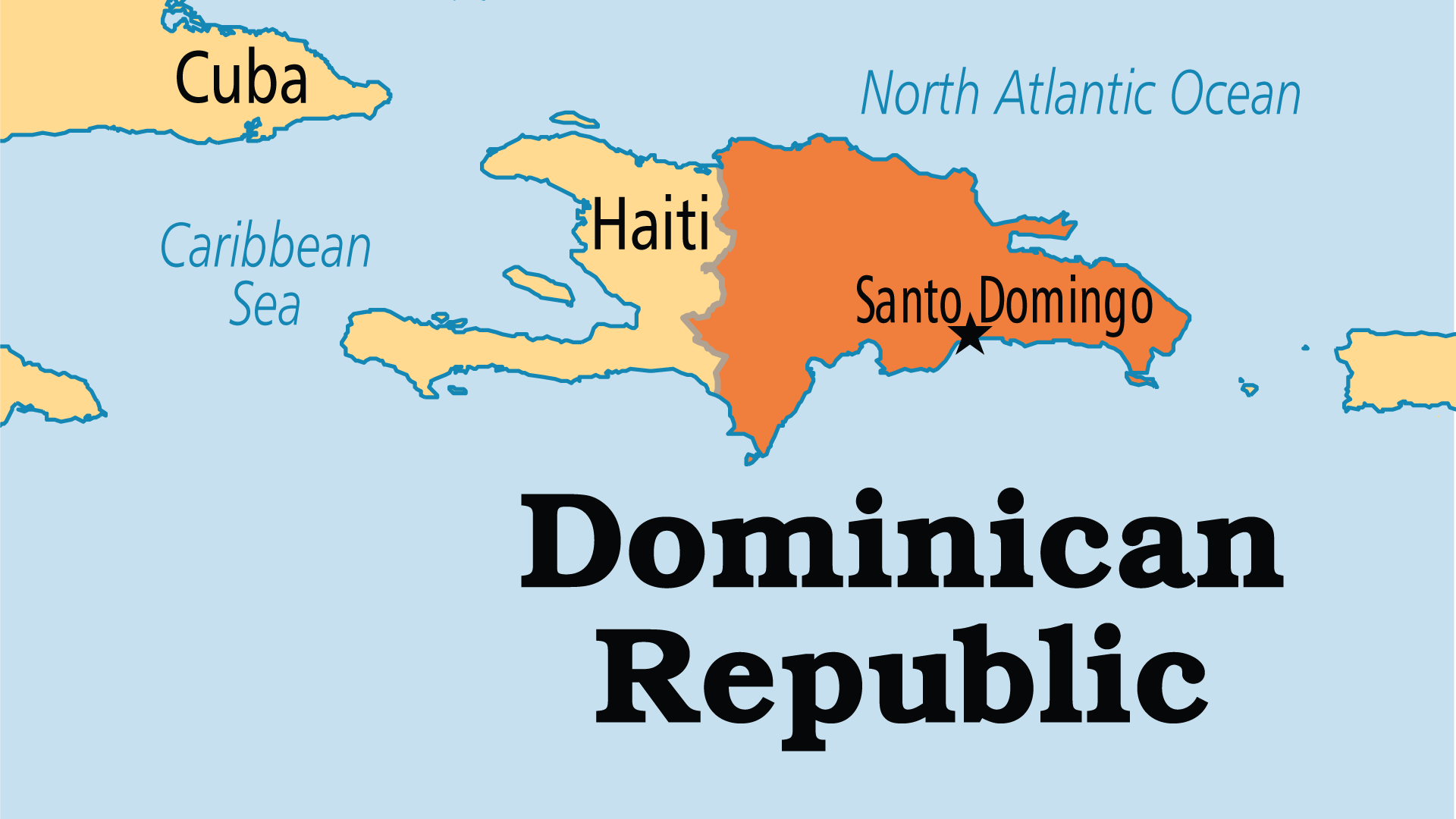
Capital Santo Domingo 3,601,000. The first European-founded city in the Americas. Urbanites 56%.
Hispanic 85%. Afro-Caribbean 7,136,000; Euro-American 1,360,000.
Haitian 14%. Speaking French Creole; about half are Dominican-born.
Other 1%. Jamaican 25,000; Chinese 9,000; Lebanese 3,200; Japanese 1,700.
Literacy 82%. Official language Spanish. All languages 3. Languages with Scriptures 2Bi.
Growth in the early 1970s has been replaced by devastating decline prompted by world recessions, a bloated bureaucracy and a corrupt government spending freely on costly prestige projects. Although the '90s have seen some improvement through light industry and tourism, 40% live in deep poverty and unemployment is still near 28%. HDI 0.726; 88th/174. Public debt 28% of GNP. Income/person $1,600 (6% of USA).
Independence achieved four times twice from Spain (1821/65), once from Haiti (1844) and once from the USA (1924)! Thirty years of repressive dictatorship ended in 1961, but instability and civil war prevailed until 1966. Subsequent democratic governments have proved manipulative and corrupt, leaving the poor and the oppressed Haitian under-class disenfranchized.
Catholicism is the state religion and the Church jealously guards its privileged political and economic clout. There is freedom of religion in basic rights for non-Catholics.
| Religions | Population % | Adherents | Ann.Gr. |
| Christian | 95.15 | 8,083,314 | +1.6% |
| non-Religious/other | 2.47 | 209,835 | +4.0% |
| Spiritist | 2.18 | 185,198 | +3.4% |
| Buddhist | 0.10 | 8,495 | +3.8% |
| Baha'i | 0.07 | 5,947 | +1.7% |
| Muslim | 0.02 | 1,699 | +1.7% |
| Jewish | 0.01 | 850 | +1.7% |
| Trans-blocGroupings | pop.% | ,000 | Ann.Gr. |
| Evangelical | 7.6 | 644 | +3.2% |
| Charismatic | 11.8 | 999 | +2.1% |
| Pentecostal | 3.2 | 276 | +3.4% |
Missionaries from Dominican Republic
P,I,A 72 in 9 agencies to 8 countries: Dominican Rep. 55.
Missionaries to Dominican Republic
P,I,A 283 in 50 agencies from 11 countries: USA 244, Korea 13, Brazil 8.

1 Evangelical growth came relatively late, but took off in the 1970s and continued through the '90s as Evangelicals strove to multiply churches and take the gospel to 1 million Dominicans by 2000. During the '90s the number of evangelical churches increased from about 2,000 to 3,200.
1 Columbus' importation of sugar cane has been the source of 500 years of wealth and misery. It was one factor in the genocide of the one million indigenous Arawak Taino people, the importation of slaves in the past and also the present exploitation of Haitian labour. Another factor is EU distortion of the world sugar market by exporting under-priced, subsidized beet sugar. Pray for more fair and considerate treatment of the poor by both the Dominican government and richer nations in their trade policies.
2 Religious freedom is not yet an issue completely resolved for non-Catholics. The 1954 Concordat limits that freedom in taxation and government institutions. CODUE, one of the two evangelical umbrella networks, seeks to coordinate activities to ensure equality for all in the sight of the law. This has led to greater unity among Evangelicals than hitherto.
3 The major challenges confronting Christians are:
a) Retention of those converted. There has been growth in many denominations, especially Pentecostals, CMA and the several Church of God groups, but only a small proportion of those who respond through evangelism become members.
b) Development of Christian ethics for Christian involvement in a society where corruption, crime and promiscuity are rampant.
c) Cultivation of a missions vision despite pervasive poverty. There are over 70 Dominican evangelical missionaries, of which 30 are cross-cultural.
4 Leadership for the churches is a constant challenge. Emigration of the gifted and moneyed to Puerto Rico and the USA is a loss the growing churches can ill afford. Pray for vision, commitment and stickability for all called to Christian work. Pray also for those willing to serve in the poorer, rural areas. Pray that the seven or more accredited, theological training schools and the National Evangelical University may provide spiritual, mature and stable leaders for the future.
5 The large Haitian under-class has been the most responsive of all. The Nazarene and Christian Reformed congregations have multiplied. Haitians are immigrants, or descendants of immigrants, who are often despised by Hispanics yet needed as sugar-cane and manual workers. They face discrimination from Dominicans even Christians, and the question of their emancipation is a major unresolved issue that must be faced by both government and people. Pray for church leaders and their congregations to be good witnesses in this tense and inequitable situation.
6 The less evangelized for prayer:
a) The unchurched majority is nominally Christian but occultism is widespread, pervasive and strong. Maybe more than 4,000 villages have no evangelical witness.
b) The middle and upper classes have relatively fewer Evangelicals. CMA have majored on reaching them.
c) Youth. There are 30 universities and colleges with 150,000 students, but the need to work to pay for tuition, lack of job prospects and purpose in life, cripple initiative. Pray for the UJC(IFES) with its university (5) and school (3) groups and its need for more staff to extend the ministry. CCCI has a large contingent of workers in campus ministry.
d) The Chinese, who have only two congregations of believers among them.
The above information and prayer material is an excerpt from the full text of Operation World for today's date. To view the prayer calendar for the year click here. If you would like the material for other days in the prayer calendar, you can purchase Operation World (click here for more information). Operation World content © 2001 Patrick J. St. G. Johnstone. All Rights Reserved. See Policy for use and reproduction permissions. Published by Paternoster Lifestyle (an imprint of Paternoster Publishing). Web site development by Global Mapping International.