![]() |
Malawi | ![]() |
| Republic of Malawi | ||
| August 2 |
| Africa |
| |||||||||||||||||||||||||||||||||||||||||||||||||||||||||||||
| Population | Ann.Gr. | Density | |
| 2000 | 10,925,238 | +2.47% | 92 per sq. km. |
| 2010 | 13,912,265 | +2.49% | 117 per sq. km. |
| 2025 | 19,958,349 | +2.29% | 168 per sq. km. |
Population could decline through AIDS deaths.
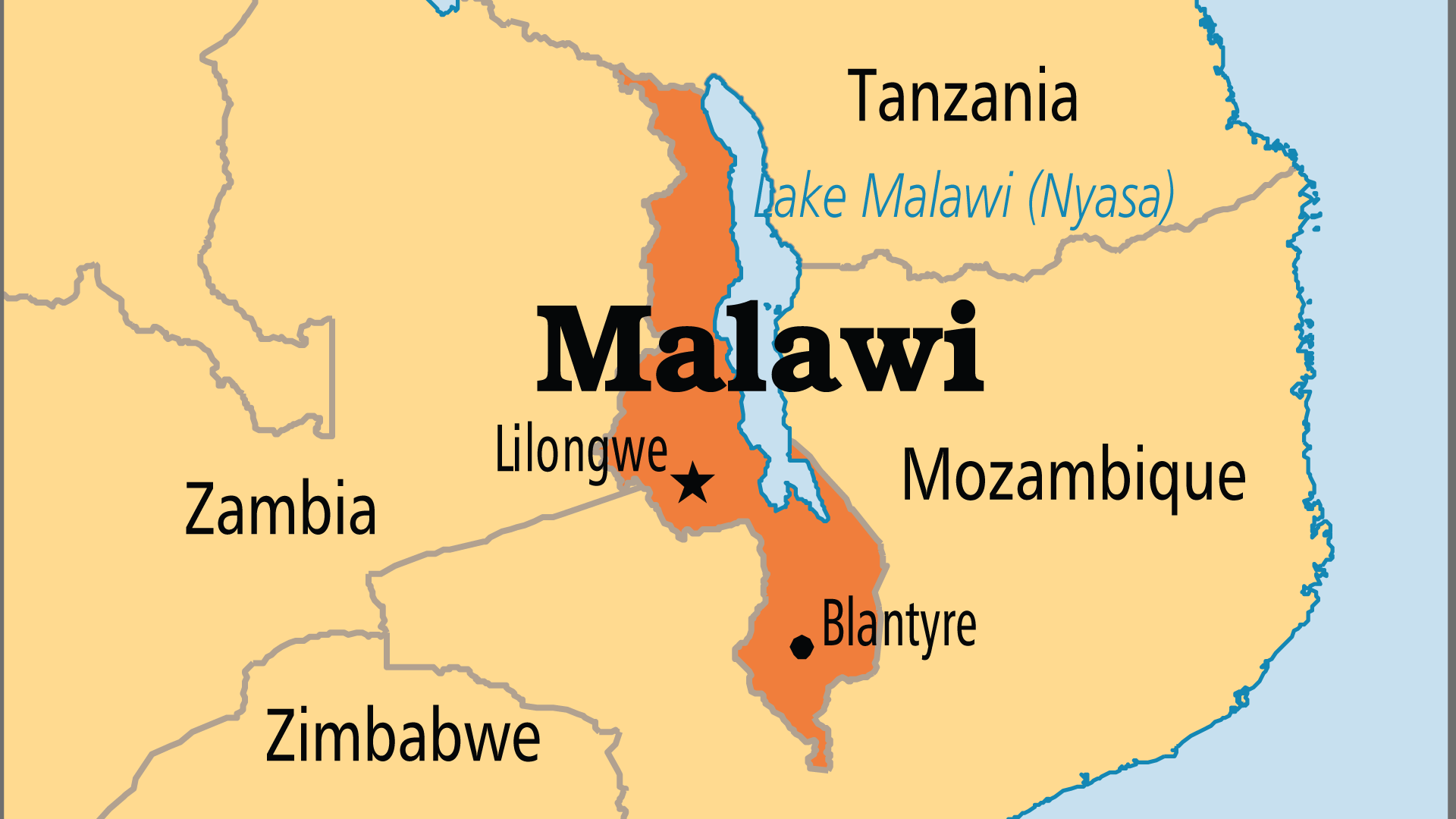
Capitals Lilongwe (ministerial and financial) 480,000; Blantyre (commercial and judicial) 500,000. Urbanites 11%.
Over 22 Bantu peoples:
Maravi 81%. Chewa 5.7 mill.; Nyanja 1.3m; Tumbuka 940,000; Tonga 170,000.
Southern peoples 16%. Yao 1m; Sena(3) 270,000; Lomwe 250,000; Ngoni (being absorbed into Chewa) 75,000.
Northern peoples 1.6%. Ngonde 85,000; Lambya 45,000; Nyakusa 25,000.
Other 1.4%. South Asian 30,000; English-speaking 17,000. Also Mozambicans, Zambians, etc.
Literacy 56% (functionally half this). Official languages Chewa and English. All languages 15. Languages with Scriptures 8Bi 3por 3w.i.p.
Well-watered and fertile but impoverished by overpopulation, geography (civil wars in Mozambique), falling world prices for tobacco, tea and sugar, poor communications to the outside world and AIDS. Heavily dependent on international aid and on rainfall there were famine conditions in 1997/8. Many Malawians work in other lands. HDI 0.399; 159th/174. Public debt 97% of GNP. Income/person $210 (0.67% of USA).
Independent from Britain in 1964. Dr. Hastings Banda ruled for 30 years as a colourful but ruthless dictator. Economic stability was gained at the expense of political freedom. Internal and international pressure against increasing corruption led to multi-party elections in 1993. Democracy under the rule of Muslim President Bakili Muluzi has only marginally improved the lot of ordinary Malawians.
Freedom of religion, but some suspect a favouring of the Muslim minority.
| Religions | Population % | Adherents | Ann.Gr. |
| Christian | 79.98 | 8,738,005 | +2.8% |
| Muslim | 13.00 | 1,420,281 | +2.9% |
| Traditional ethnic | 6.20 | 677,365 | -2.6% |
| non-Religious/other | 0.60 | 65,551 | +17.7% |
| Baha'i | 0.20 | 21,850 | +2.5% |
| Hindu | 0.02 | 2,185 | -5.5% |
| Trans-bloc Groupings | pop.% | ,000 | Ann.Gr. |
| Evangelical | 20.4 | 2,228 | +10.5% |
| Charismatic | 16.1 | 1,763 | +13.0% |
| Pentecostal | 6.4 | 699 | +26.6% |
Missionaries from Malawi
P,I,A An est. 100 in 14 agencies to 9 countries: Malawi 67, Mozambique 20.
Missionaries to Malawi
P,I,A 436 in 68 agencies from 20 countries: USA 200, UK 50, South Africa 42, Zimbabwe 29.

1 The courage and outspokenness of Catholic and Protestant leaders were a major factor in ending the dictatorship through democratic change.
2 Malawi continues to be spiritually the most receptive country in central Africa. Years of evangelical outreach (AE, DM, Global Field Evangelism, CFAN evangelistic campaigns), burgeoning youth outreach (SU, IFES), New Life For All programmes in the churches, multiplied house meetings and prayer movements have all contributed to the blessing. Since 1996 there has been a move of the Spirit at every level of the Anglican Church. The Anglican youth organization One In Christ Youth has had denomination-wide evangelistic impact. The gospel has penetrated into nearly every section of society, and in places there have been local revivals. Newer charismatic, Pentecostal and evangelical denominations have grown rapidly.
1 Malawi has remained relatively peaceful since independence in a region of devastating wars and turmoil. Yet these wars have exacted a terrible economic toll in under-development. Raised expectations of democratic government have not been realized. Pray that the nation may be led by leaders of integrity and that the new democracy may lead to the improved well-being of the people.
2 The growth of Islam is a major challenge. Over 90% of the Yao are Muslim and constitute the bulk of Muslims in Malawi. The majority of the Asians are also Muslim, as is the President himself. The Qur'an has been translated into Chewa. Islam has become more visible and confident and Muslim aid projects have increased. Malawi is now the Southern African base for the Africa Muslim Agency. Expansion of Islam to other peoples is not extensive yet but is taking place. Pray for good relations between Christians and Muslims and for an effective ministry to bring Muslims to a personal relationship with Christ.
3 AIDS is a terrible, but under-reported scourge. Life expectancy has been cut to 43, officially 16% (and perhaps over 30%) of all 14- to 49-year-olds are infected, but 60% of new infections in the 14-25 age group are girls. There are up to 400,000 AIDS orphans. The viability of families, villages, the economy and even the state are threatened. Pray that churches might be better equipped and envisioned to face AIDS with effective ministries. SU has launched an effective Aid for AIDS prevention campaign in primary schools.
4 The CCAP is the largest Protestant denomination and the direct fruit of the vision of the 19th Century explorer, David Livingstone. It is a union of the churches planted by the South African Dutch Reformed Church, the Church of Scotland and the Free Church of Scotland. Pray for revival as nominalism and formalism predominate, yet there are also strong evangelical leaders and congregations. Pray that second- and third-generation Christians may come to personal faith, and for many to be called into full-time ministry.
5 The major issues to be tackled by the churches are:
a) Maintaining effective ministry in the midst of deep poverty and the growing AIDS crisis.
b) Training new workers for spiritually weak rural churches few can afford the training or the subsequent support. TEE courses are run by the Brethren and Baptists.
c) Effective theological education. There are 13 Protestant and two Roman Catholic seminaries or Bible schools. Pray that the CCAP theological faculty at Zomba might take a more strongly evangelical stand. Pray for many to be called into the ministry, and for the provision of funds to enable them to complete their studies.
d) Unity. Pray for more cooperation between the Evangelical Association of Malawi (EAM), the Christian Council (CCM) and the CHAPEL network of Pentecostals and charismatics. Pray that the Malawi National Initiative for Mission and Evangelism may unite the churches in effective evangelism and outreach.
e) A good survey of Malawi to analyze the unfinished task.
6 Student ministries have flourished (Life Ministries-CCCI and SCOM-IFES). There are over 500 SCOM high school groups and a further 25 in the universities and colleges with over a fifth of the 120,000 tertiary students involved. Students are open to the gospel and to error. Pray for godly leadership for these groups and ultimately for the Church and nation as a result.
7 The least evangelized. Pray that both Malawian and expatriate workers may effectively share the love of Christ with:
a) The Yao, who remain the biggest challenge in Malawi. More orthodox Islamic practices are increasingly replacing the prevalent folk Islam. In earlier decades the Anglicans, CCAP, Catholics and Baptists won about 3% of the Yao, but these have become a separate people in the process. Current attempts are being made by a partnership of evangelical missions: IMB-SBC, SIM, BiC, AoG, Deeper Life and others, but very few have come to Christ in the past few decades and there is not yet an indigenous Yao Church.
b) The Ngonde and Lambya in the far north, who are less well evangelized, though there are some churches among them.
c) The Sena and Lomwe of the Shire valley in the south with relatively few Christians. The majority of these peoples live in neighbouring Mozambique where response to the gospel has mushroomed since peace came to that land.
d) The Gujarati and Tamil, the main groups of Asians. Only sporadic attempts are made to evangelize these Hindu and Muslim peoples.
8 Expatriate missionaries are primarily engaged in supporting existing denominations and agencies in training, outreach and Christian institutions. Pray for a deep heart identification with Malawian believers and fruitful ministries in this day of opportunity. The largest agencies: CCCI (62 workers), all Presbyterians (54), IMB-SBC (41), SdA (36), CoN (17), Churches of Christ (17), AoG (14), Anglicans (14), PAoC (10), SIM (6).
9 Christian help ministries for prayer:
a) Bible translation. The completion of the whole Bible in Lomwe, Ngonde, Sena and Yao are the major challenges. Several other languages are without a New Testament and may need translations.
b) The Bible Society. There are big demands for Scriptures for local use and for the large refugee community ; but limited funds to meet them. Many rural Christians have no Bibles. The Bible on cassette is a developing ministry.
c) Literature. This is much sought after, but expensive. CLAIM is a joint publishing and distribution venture involving 14 denominations and agencies with 37 outlets and 200 agencies, as well as programmes to train workers. Pray for the adequate supply of quality reading material for the literate, growing, but poor Church.
d) Christian radio. The national broadcasting network regularly airs Christian programmes. The Baptist Media Centre is a key resource for many churches and agencies in preparing materials, tapes and programmes. TWR-Swaziland broadcasts in Chewa-Nyanja (13 hrs/wk), Lomwe (2), Tumbuka (1.5) and, together with FEBA, Yao (2). The African Bible College in Lilongwe and TWR in Blantyre have local FM radio stations.
The above information and prayer material is an excerpt from the full text of Operation World for today's date. To view the prayer calendar for the year click here. If you would like the material for other days in the prayer calendar, you can purchase Operation World (click here for more information). Operation World content © 2001 Patrick J. St. G. Johnstone. All Rights Reserved. See Policy for use and reproduction permissions. Published by Paternoster Lifestyle (an imprint of Paternoster Publishing). Web site development by Global Mapping International.