![]() |
Portugal | ![]() |
| Portuguese Republic | ||
| September 20 |
| Europe |
| |||||||||||||||||||||||||||||||||||||||||||||||||||||||||
| Population | Ann.Gr. | Density | |
| 2000 | 9,874,853 | +0.04% | 107 per sq. km |
| 2010 | 9,776,944 | -0.14% | 106 per sq. km |
| 2025 | 9,348,354 | -0.35% | 101 per sq. km |
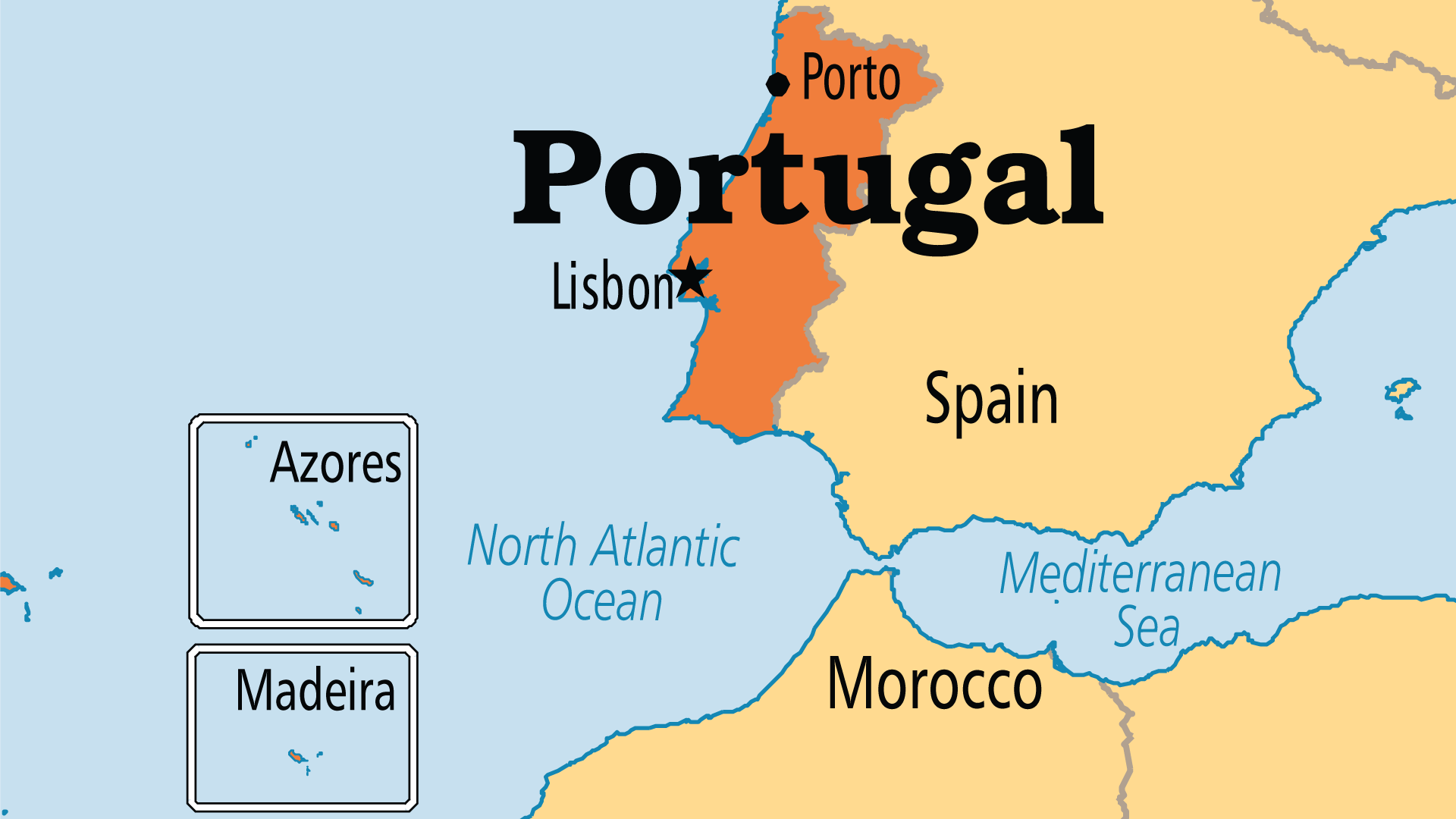
Capital Lisbon 2,800,000. Other major city: Porto 1,700,000. Urbanites 30%.
Portuguese 97%. Over 1 million live and work in other European countries.
Indigenous minorities 1.1%. Roma (Gypsy, 3) 80,000; Galician 15,000; Mirandesa 10,000.
EU Citizens 0.5%. British 13,000; Spanish 10,000; German 9,000; French 6,000; Dutch 3,000.
Other 1.4%. Cape Verdian 40,000; North African Arab 28,000; Brazilian 20,000; Angolan 16,000; Guinea-Bissau 13,000, Goanese 8,000.
Literacy 92%. Official language Portuguese. There are 190,000,000 Portuguese speakers world-wide. All languages 7.
Impoverished by years of dictatorship and colonial wars. Rapid improvement of living standards since entry into the EU in 1986. Manufacturing and tourism are major components of the GNP. Unemployment is only 4%. HDI 0.858; 28th/174. Public debt 37% of GNP. Income/person $11,000 (35% of USA).
Independent kingdom from 1143. A republic in 1910. The 1974 revolution ended 48 years of dictatorship whereupon a socialist democracy was instituted. All Portugal's African colonies (Mozambique, Angola, Guinea-Bissau, São Tomé & Príncipe, Cape Verde) were hastily granted independence in 1975. Membership of the EU has brought stability and strengthened democracy.
Freedom of religion since 1974, but with the Roman Catholic Church retaining some privileges. New laws in planning could lead to granting the same privileges to all minority religions.
| Religions | Population % | Adherents | Ann.Gr. |
| Christian | 94.39 | 9,320,874 | -0.1% |
| non-Religious/other | 5.00 | 493,743 | +3.1% |
| Muslim | 0.50 | 49,374 | +4.6% |
| Hindu | 0.10 | 9,875 | +2.2% |
| Jewish | 0.01 | 987 |
| Trans-bloc Groupings | pop. % | ,000 | Ann.Gr. |
| Evangelical | 3.1 | 307 | +2.5% |
| Charismatic | 2.9 | 290 | +2.5% |
| Pentecostal | 2.6 | 256 | +1.5% |
Missionaries from Portugal
P,I,A 215 in 26 agencies to 19 countries: Portugal 43, France 19, USA 18.
Missionaries to Portugal
P,I,A 411 in 66 agencies from 15 countries: USA 178, Brazil 103, UK 44, Norway 43, Spain 32.

1 The 25 years of religious freedom have resulted in the steady and increased growth of Evangelicals from 55,000 in 1975 to over 307,000 in 2000.
1 Religious and political freedoms gained in 1975 have transformed the nation, but the ancient heart-bondages remain. The veneration of Mary is a 'Christian' veneer over the old paganism and an estimated 90% of the population consult spiritist mediums and witches. To this are added the new bondages of materialism, self-centredness and alcohol and drug abuse. The teachings of the Jehovah's Witnesses, Mormons and New Age philosophies have gained a wide hearing. Pray for many to be released and for discerning Christian leaders able to effectively expose these false doctrines.
2 The Roman Catholic Church is strongly traditional and has much influence, but needs renewal. The north is more loyal to the Church, but in the centre and south the Church is becoming irrelevant to the secularized majority of the population. Pray for a renewing work of the Holy Spirit in which many are opened to the illumination of the Scriptures, freed from traditionalism and introduced to a warm personal relationship with Jesus.
3 Evangelical growth has accelerated in the 1990s, especially among Pentecostal and charismatic groups, but is also hampered by weaknesses which constrain that growth.
a) Serious divisions. Many denominations have suffered acrimonious splits especially some Pentecostal denominations. An over-emphasis on prosperity teaching has divided congregations and brought confusion and disillusionment to many.
b) The need for a united vision. The Portuguese Evangelical Alliance has gained in stature and influence in recent years. Pray that God may grant wisdom, unity and faith for advance together to Portuguese Evangelicals.
c) The lack of concern for world evangelization. The Portuguese Church has a unique role to play because of the wide use of their language. There is too little involvement in missions in many evangelical churches the exception being the Assemblies of God, the Mana churches and several individual congregations. YWAM's King's Kids ministry and Discipleship Training Schools are challenging young people for missions.
4 Many congregations lack full time workers with adequate theological depth and spiritual maturity. There are nine seminaries, including the Assemblies of God, Portuguese Bible Institute (founded by GEM), Presbyterian, Baptist and Bethel Bible Institutes (founded by Brazilian missionaries). The PBI now offers university-level and post-graduate degrees. The PBI, Baptists and ICI (AoG) run TEE programmes and Núcleo, a widely used Bible Correspondence Course. Pray that these may contribute to meeting the ministry needs of the churches.
5 There remain pioneer challenges despite recent church growth. Pray for:
a) The seven northern and north-eastern provinces which are strongly traditional Catholic; relatively few evangelical churches exist. Brethren, Baptists, AoG, Missão Antioqía, GEM, TEAM and ECM have church-planting programmes in the area.
b) The four provinces in the south which are poor, with few people ever going to church. Attendance at mass by people in Beja province is less than 3% of the population. Evangelical churches are few.
c) The 316 counties, 69 of which still have no evangelical congregation. In these counties live 800,000 people.
d) The 4,400 localities. Only 768 have a resident evangelical witness.
e) Madeira Island (273,000) which has only 13 small evangelical churches, and the Azores (253,000) with a further 26, most being Assemblies of God and Baptist. Four of the nine islands have no churches.
f) Ethnic minorities there is little specific outreach to the 50,000 or so African and Arab Muslims or to the Hindu Goanese or Macau Chinese.
6 Young people are often spiritually neglected.
a) Drug abuse is a growing problem over 50% have experimented with drugs. Teen Challenge, Betel-Spain and also TEAM and ECM have ministries of rehabilitation and discipling addicts.
b) Student work is still in a pioneer stage. GBUP(IFES) has a ministry that is established in eight universities and also in some high schools. CCCI and Navigators also have a ministry on several campuses.
c) International students are a specific focus of GEM along with a year-long internship programme for short-term missionary training.
d) SU and CEF have ministries among school children.
7 Expatriate missions have not found Portugal easy for ministry. Pray for perseverance, cultural adaptation and fruitfulness. Quality workers are needed in the many unreached areas for ministry in evangelism, church planting, Bible training and music. Some significant missions: GEM (28), TEAM (17), AoG (15), Betel-Spain (11), CoN (7), Word of Life (7). A growing number of Brazilian missionaries are entering the land (104 in 1998) and finding acceptance once they realize that Portugal is different from Brazil.
a) The Bible Society has a growing national and international ministry in Bible production and distribution.
b) Núcleo which has a vital coordinating ministry for the Body of Christ in research, publishing, printing tracts and distributing cassettes and films.
c) Ten Christian bookstores, one run by CLC.
d) CEDO, a gospel broadsheet ministry of WEC sends out 150,000 copies four times a year to 60 countries around the world. The response is good from Mozambique and Angola, and is increasing from Portugal.
e) Christian radio is widely used. Local FM and medium-wave stations are used by various denominations and agencies. The Evangelical Alliance produce two TV programmes weekly. The Catholics have a TV station.
f) The Internet is a new area for evangelistic ministry which needs to be taken up by Christians with the right skills.
The above information and prayer material is an excerpt from the full text of Operation World for today's date. To view the prayer calendar for the year click here. If you would like the material for other days in the prayer calendar, you can purchase Operation World (click here for more information). Operation World content © 2001 Patrick J. St. G. Johnstone. All Rights Reserved. See Policy for use and reproduction permissions. Published by Paternoster Lifestyle (an imprint of Paternoster Publishing). Web site development by Global Mapping International.