Rwanda
Republic of Rwanda
October 1
Africa


click to enlarge

GEOGRAPHY

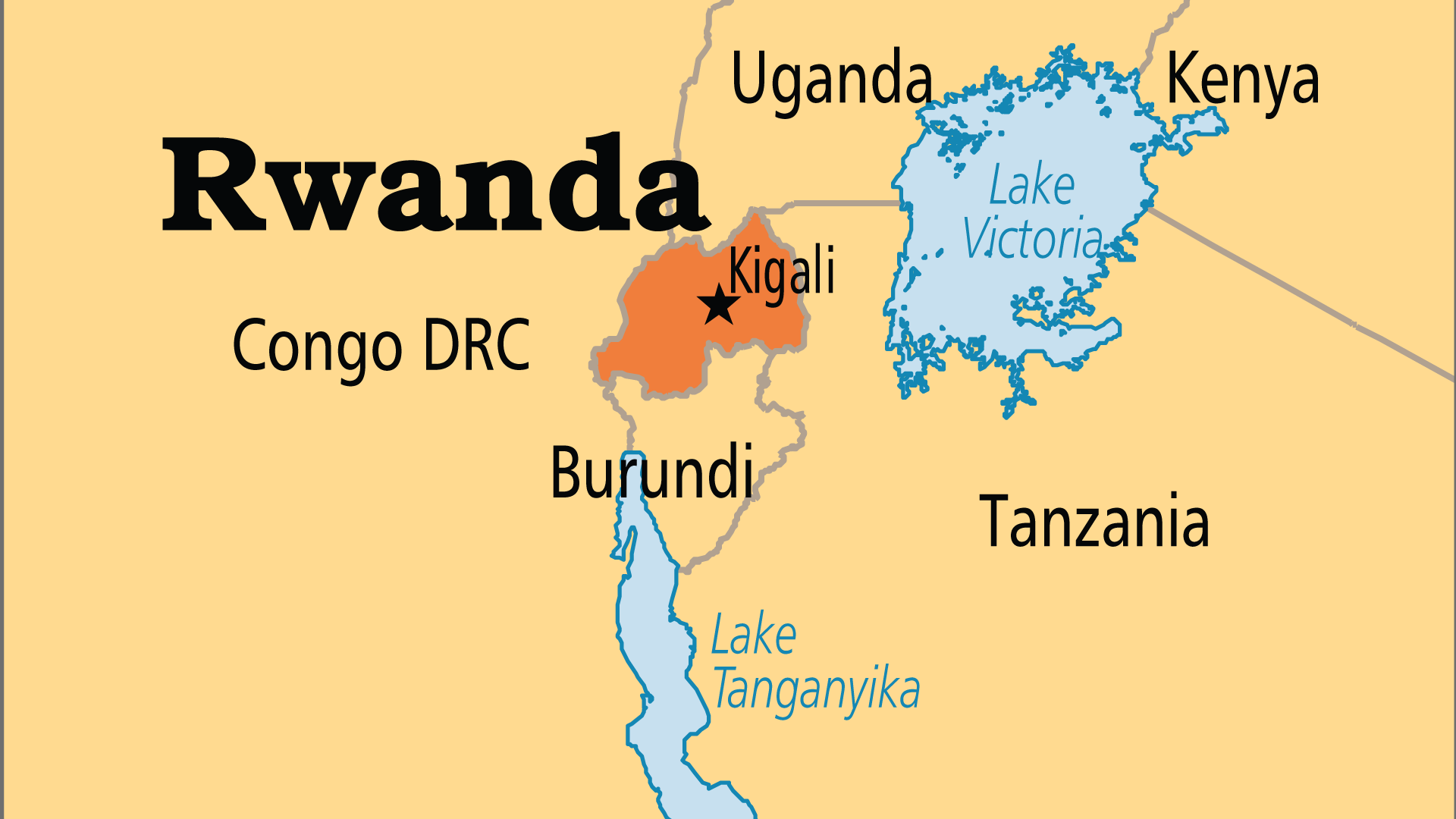
Area 26,338 sq.km. A fertile, mountainous country similar to its southern neighbour, Burundi.

Population Ann.Gr. Density
1990 6,987,000 +2.9% 265 per sq. km.
1995 5,259,000 -5.5% 200 per sq. km.
2000 7,733,127 +8.02% 294 per sq. km.
2010 9,534,549 +2.10% 362 per sq. km.
2025 12,426,835 +1.51% 472 per sq. km.

A massive 25% population loss in 1994-5 through massacres, genocide (nearly 1 million) and flight of refugees (over 1 mill.). Most of the latter have returned.

Capital Kigali 237,782. Urbanites 5.4%.

PEOPLES

Hutu (Bantu) 81%. The former serf class.

Tutsi (Nilotic) 18%. The former feudal rulers.

Twa (Pygmy) 0.3%.

Other 0.7%.

Literacy 60%. Official languages French, English, kiNyarwanda. The entire population speaks kiNyarwanda.

ECONOMY

Fertile agricultural land with few natural resources. Main sources of foreign exchange are coffee, tea and aid. Over-population and distance from the sea inhibit development. Nearly 40 years of conflict between the Hutu and Tutsi peaked in the terrible events of 1994-5. The economy was severely dislocated and continues to be so with the ongoing Central African War mainly in neighbouring Congo-DRC. There have been recent improvements as the government attempts to restructure and privatize the economy. HDI 0.379; 164th/174. Public debt 59% of GNP. Income/person $210 (0.7% of USA).

POLITICS

A feudal Tutsi monarchy which continued through German colonial occupation (1899-1916) and Belgian Mandate (1916-1962). A Hutu revolt overthrew the Tutsi government in 1959 with many Tutsi killed or driven into exile. A Tutsi invasion from Uganda in 1990 led to conflict, many deaths and the displacement of thousands of people. Hutu extremists seized power in 1994 and put into action the planned genocide of the Tutsi minority and Hutu moderates. In 100 days 800,000 perished. The more disciplined Tutsi-led forces gained control and over a million Hutu fled to surrounding lands. The extremist Interahamwe Hutu militia then spread terror and destruction in the Congo and areas of Rwanda. The transitional government struggles to reduce inter-ethnic hatred and institute a non-racial democracy while protecting the minorities. All international efforts to broker a lasting peace failed to overcome the fears and hatred of extremists.

RELIGION

There is full freedom of religion.

Religions Population % Adherents Ann.Gr.
Christian 80.83 6,250,687 +8.0%
Muslim 10.50 811,978 +8.4%
non-Religious/other 4.50 347,991 +8.0%
Traditional ethnic 3.97 307,005 +6.8%
Baha'i 0.20 15,466 +8.0%

Christians Denom. Affil.% ,000 Ann.Gr.
Protestant 20 18.76 1,451 +6.5%
Independent 11 0.81 63 +11.6%
Anglican 1 10.59 819 +7.1%
Catholic 1 42.67 3,300 +8.5%
Orthodox 1 0.01 0 +0.0%
Marginal 1 0.26 20 +14.6%
Unaffiliated   7.73 597 n.a.

Churches MegaBloc Cong. Members Affiliates
Catholic C 1,133 1,813,187 3,300,000
Anglican A 2,000 245,961 819,050
Seventh-day Adventist P 909 342,664 520,000
Pentecostal P 1,859 139,423 290,000
Presbyterian P 74 120,000 216,000
Free Methodist P 200 30,000 130,000
Baptist Union P 299 36,557 110,000
Assoc des Eg Baptistes P 126 27,000 59,000
Ch of the Nazarene P 110 28,000 42,000
Jehovah's Witnesses M 92 6,828 20,000
Church of God (Clev) P 79 6,608 13,000
Assemblies of God P 51 4,892 10,782
Other denoms [23]   682 59,390 123,200
Total Christians [35]   7,614 2,860,510 5,653,000

Trans-bloc Groupings pop. % ,000 Ann.Gr.
Evangelical 22.8 1,762 +6.9%
Charismatic 9.1 706 +7.2%
  Pentecostal 4.3 336 +6.3%

Missionaries from Rwanda
P,I,A 46 in 6 agencies – most in Rwanda.

Missionaries to Rwanda
P,I,A 76 in 23 agencies from 13 countries: USA 33, UK 8, Denmark 7, Korea 6.


click for legend

Challenges for Prayer

1 The genocide that caused the death of a million men, women and children stunned the world and traumatized the nation.

a) Rwanda desperately needs peace and an end to centuries of inter-ethnic hatred. Pray that the transitional government, the churches and international bodies may succeed in achieving this.

b) The United Nations as well as Western and African governments all failed to act in time and with courage to prevent the 1994 calamity. Death, despair and disillusionment prevail. Pray that this dark cloud may be lifted. Conditions were slowly improving by 2000.

c) The transitional government will end in 2003. Pray that a fair, stable, non-racial political and social democratic framework may be established by then.

d) The need for justice. Many of the most responsible for the genocide are still on the loose. Over 125,000 have been detained because of their possible involvement, with many innocent among the guilty, but the courts are only slowly processing them – at present rates it will take 200 years! Of Rwanda's 719 magistrates in 1994, only 250 survived. Pray for justice to be done, and to be seen to be done in a timely way.

2 The East African Revival began in Rwanda in the 1930s. The blessing was lost and the heritage of tribalism which was crucified with Jesus on the cross, forgotten. Many were shocked that a nation nearly 90% 'Christian' could sink to such barbarities. Too few Christians spoke out against the atrocities, and some even connived with the perpetrators. Pray for a deep spirit of repentance, and for revival to sweep through the churches once more. Pray that the Church may be cross-centred, Bible-based, supra-tribal and become truly prophetic and evangelistic. Recent suffering has increased the fervour of many.

3 Many Christians suffered much. Thousands of spiritual leaders were murdered. Many leaders despair of being able to cope with the desperate physical, social, psychological and spiritual damage done. Pray for all involved in reconciliation, counselling, discipling and training ministries. Bible schools and seminaries are seeking to regain lost ground in providing leaders for the future. There is a dearth of good Bible study aids. Pray that God may raise up men and women of God fitted for Rwanda's hour of need. Pray also for protection for church leaders from extremists who still want to promote tribalism and fuel ethnic hatreds.

4 Young people were deeply affected by the events of the 1990s. Pray for:

a) Ministry to university students which has had to begin from scratch. All 60 GBU(IFES) Bible study leaders lost their lives; most graduates fled. Of the 5,000 university students, 1,000 come to GBU meetings, but follow-up is hard due to lack of resources. CCCI also has a significant campus ministry.

b) Scripture Union which has a ministry among young people of all churches, thus helping to lessen denominational rivalry. Pray for blessing on the daily Bible-reading notes and extension of this ministry to the churches, for this is often the only systematic Bible training most people get. Pray also for the SU programme to develop materials for new converts – few churches have a vision for this.

c) Other Christian associations such as AEE, YWAM, YFC and Moucecore who are working to help young people overcome their problems and build up their unity as one people.

d) Orphans from genocide, war and AIDS may number 500,000. There are over 85,000 child-led families (usually young girls) caring for 300,000. Pray for churches and agencies seeking to alleviate the pain and the poverty of these children and to help initiate income-generating work for them.

5 Missionaries have returned since 1994. The demands are enormous with the lack of national Christian workers. Conditions can be emotionally harrowing – especially when engaged in helping those most affected by the war and by AIDS. Pray that their contribution might be invigorating for the Church and uplifting for the people. The largest agencies: Swedish Pentecostal Mission (25 workers), SdA (18), Evangelical Friends (6), CMS (Mid-Africa Ministry) (5), WVI (5), AoG (4), IMB-SBC (3).

6 Ministry challenges that need intercession:

a) AIDS has become another nightmare for this beautiful, but tragic land. In 2000 there were at least 400,000 infected (11% of the population) and 270,000 orphaned due to AIDS. Pray that more might be done by Christians in prevention (SU and Aid for AIDS, etc.) and in care for those affected.

b) The Pgymy Twa are marginalized. Many are itinerant potters. Some reckon that up to 75% were killed in the genocide. Relatively fewer of this people are Christian.

c) Muslims have increased significantly in the 1990s through an aggressive mosque-building programme. Many have been attracted by Muslim claims of the tolerance and peace found in Islam in contrast to the genocidal 'Christians'. Estimates of their percentage vary between 2% and 5%. There is no specific ministry equipped or committed to reach them.

d) Detainees and prisoners languishing in over-crowded prisons face a long and hopeless future. Pray for churches seeking to minister to their physical and spiritual needs.

7 Christian support ministries:

a) Christian radioTWR broadcasts in kiNyarwanda from Johannesburg, South Africa.

b) The JESUS film has been viewed by the equivalent of 40% of the population.

Internet Links

| Top | Home | Pray Today | Prayer Resources | Updates | OW Team | Contact Us | Policy | Tech Support |
.